
menu
If your robot clearly outperforms alternatives, why isn’t adoption accelerating?
This is the uncomfortable question many robotics companies face after strong pilots, positive benchmarks, and clear technical differentiation. On paper, the system works. In controlled environments, it even excels. And yet, expansion slows, deals stall, and deployments fail to scale beyond initial use cases.
It’s tempting to diagnose this as a market education problem or a sales execution issue. But in most cases, the root cause sits deeper—in how enterprises evaluate risk, align internally, and build confidence in operational change.
In robotics, adoption is not a function of technical superiority. It is a function of trust.
At Robo Success, we work with robotics companies as an adoption-first partner, helping translate technical strength into organizational confidence—because without that translation, even the most advanced systems struggle to scale.
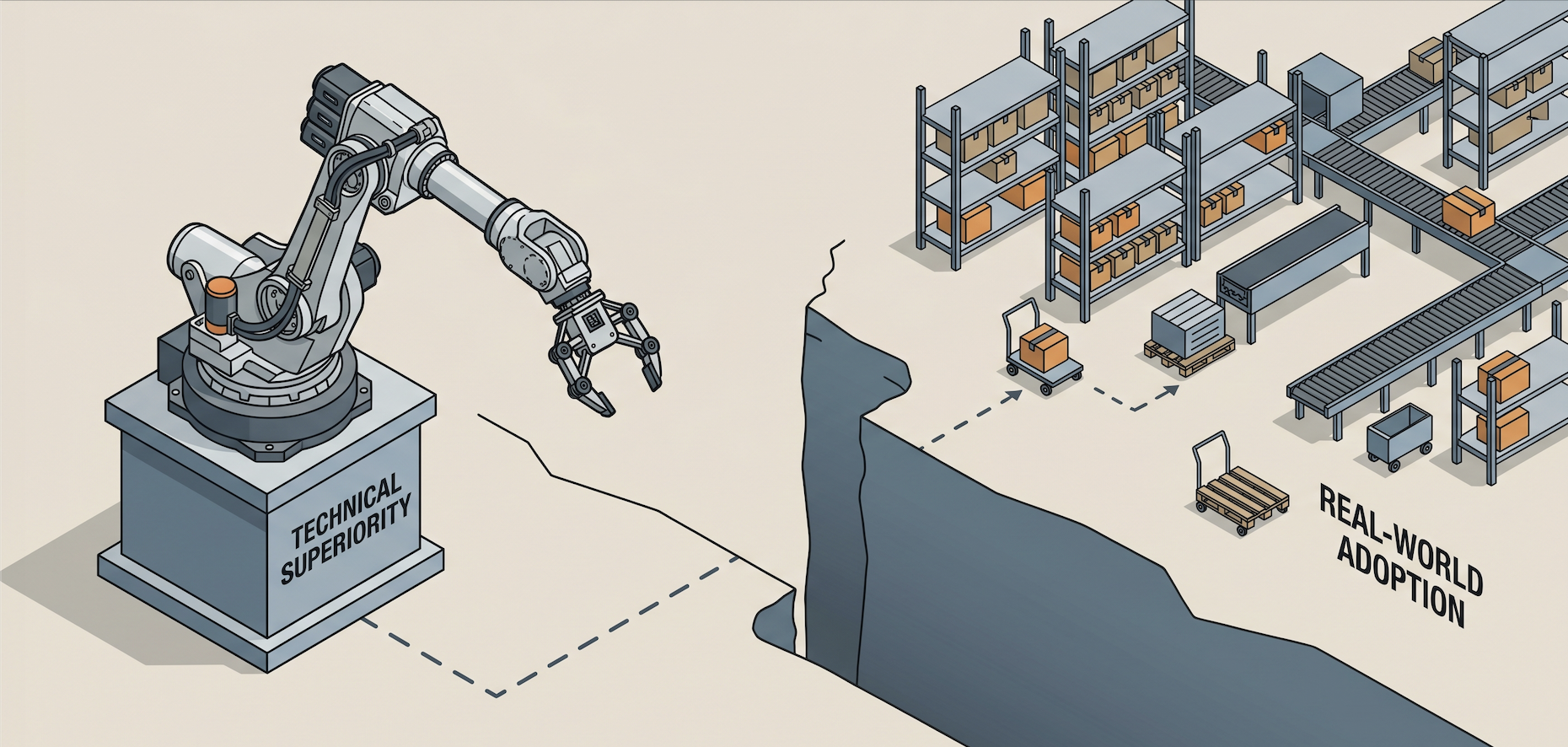
There is a persistent belief across robotics: the best product will win.
More autonomy, better perception, higher accuracy—these are seen as decisive advantages. And at the engineering level, they are. But enterprise adoption is not an engineering decision. It is a risk-managed, multi-stakeholder commitment.
When a company evaluates a robotics solution, the question is not:
“Is this the most advanced system available?”
It is:
“Can we safely integrate this into our operations without disruption?”
A technically superior system that introduces uncertainty—around uptime, integration, or usability—often loses to a less advanced solution that feels predictable and manageable.
This dynamic is well documented in broader innovation research. For example, why innovation efforts fail often comes down to organizational resistance driven by unclear risk and lack of alignment—not lack of technical merit.
In robotics, where systems interact with real environments, that resistance is amplified.
One of the most common underestimations in robotics go-to-market strategy is the complexity of the buying process.
Adoption is not a single decision made by a single stakeholder. It is a system of approvals, validations, and internal negotiations across:
Each stakeholder defines value differently. Technical superiority may resonate with engineering—but adoption requires alignment across the entire organization.
This is why many deals that appear “won” at the champion level fail to fully close or expand. The organization itself was never aligned.
In robotics, perceived risk consistently outweighs theoretical value.
A system that promises significant gains but introduces operational uncertainty creates hesitation—not because buyers don’t believe in the technology, but because they are accountable for the consequences of failure.
A failed deployment affects:
So buyers optimize for downside protection.
This is also why pilot success often fails to translate into scale. A pilot proves capability—it does not prove reliability across environments, teams, and time.
As explored in why digital transformations fail, organizations don’t resist change—they resist transitions that lack structure, clarity, and risk mitigation. Robotics deployments face this same challenge, often more intensely.
Robotics companies are strong at proving performance:
But buyers are evaluating something different:
“Are we ready to operate this system daily?”
This includes:
These are operational questions—not technical ones.
Adoption stalls when these answers are unclear, even if the technology itself is exceptional.
Trust in robotics is not built through messaging—it is built through structure.
Organizations gain confidence when they can clearly see:
Without this clarity, even strong products feel risky.
With it, even less advanced systems can feel safe to adopt.
This is the core shift from product-first thinking to adoption-first thinking.
Instead of asking:
“How do we prove the technology is better?”
The question becomes:
“How do we make adoption feel predictable and low-risk?”
Many robotics companies reach the same frustrating stage:
And then—no expansion.
This happens because pilots are supported environments. They rely on:
Scaling removes those conditions.
Now the system must function across:
If the adoption system isn’t designed for this reality, growth stalls.
Robotics growth is often framed as a top-of-funnel problem.
But more often, it is an internal alignment problem within the buyer’s organization.
If messaging only speaks to technical teams, operations hesitate.
If case studies highlight performance but ignore implementation, finance delays.
If risk isn’t clearly addressed, safety teams push back.
Alignment means:
This is where many technically strong companies underperform—they assume the product will carry the deal.
In reality, the system carries the decision.
For a deeper perspective on this shift, our work on robotics go-to-market and adoption strategy explores how alignment, trust, and de-risking drive scalable growth.
Technical superiority still matters—but it is not the primary driver of adoption.
The real advantage lies in:
This reframing shifts how companies grow:
At Robo Success, this is the foundation of how we help robotics companies scale—not by amplifying what the product does, but by ensuring organizations are ready to adopt it.
The robotics industry does not lack innovation. It lacks scalable adoption.
The assumption that better technology guarantees success overlooks how enterprises actually make decisions—carefully, collectively, and with a strong bias toward minimizing risk.
Companies that recognize this shift outperform not because their robots are dramatically better, but because their systems make adoption feel safe, structured, and inevitable.
Technical superiority may open the door.
But organizational confidence is what gets you through it.
Let's build something revolutionary - together