
menu
Robotics companies often assume that if a technology is innovative enough, adoption will follow.
But what if the opposite is true?
What if the biggest barrier to growth is not convincing buyers that your robot is new, but convincing them that it is dependable?
Across the robotics industry, founders invest years developing novel capabilities, breakthrough autonomy, advanced perception systems, and proprietary AI models. Yet many of those same companies struggle to convert pilot success into scaled deployment.
The problem is rarely a lack of innovation.
More often, it is a lack of confidence.
Enterprise buyers are not purchasing robotics because they want innovation. They are purchasing robotics because they want predictable outcomes. The distinction sounds subtle, but it fundamentally changes how companies position products, communicate value, and drive adoption.
At Robo Success, we frequently see this gap emerge when robotics companies move from technical validation to commercial scale. Teams that successfully sell innovation to investors, engineers, and early adopters often discover that enterprise buyers evaluate an entirely different set of criteria. Adoption becomes less about technological possibility and more about operational certainty.
Understanding the difference between selling innovation and selling reliability is often the difference between generating interest and generating deployment.
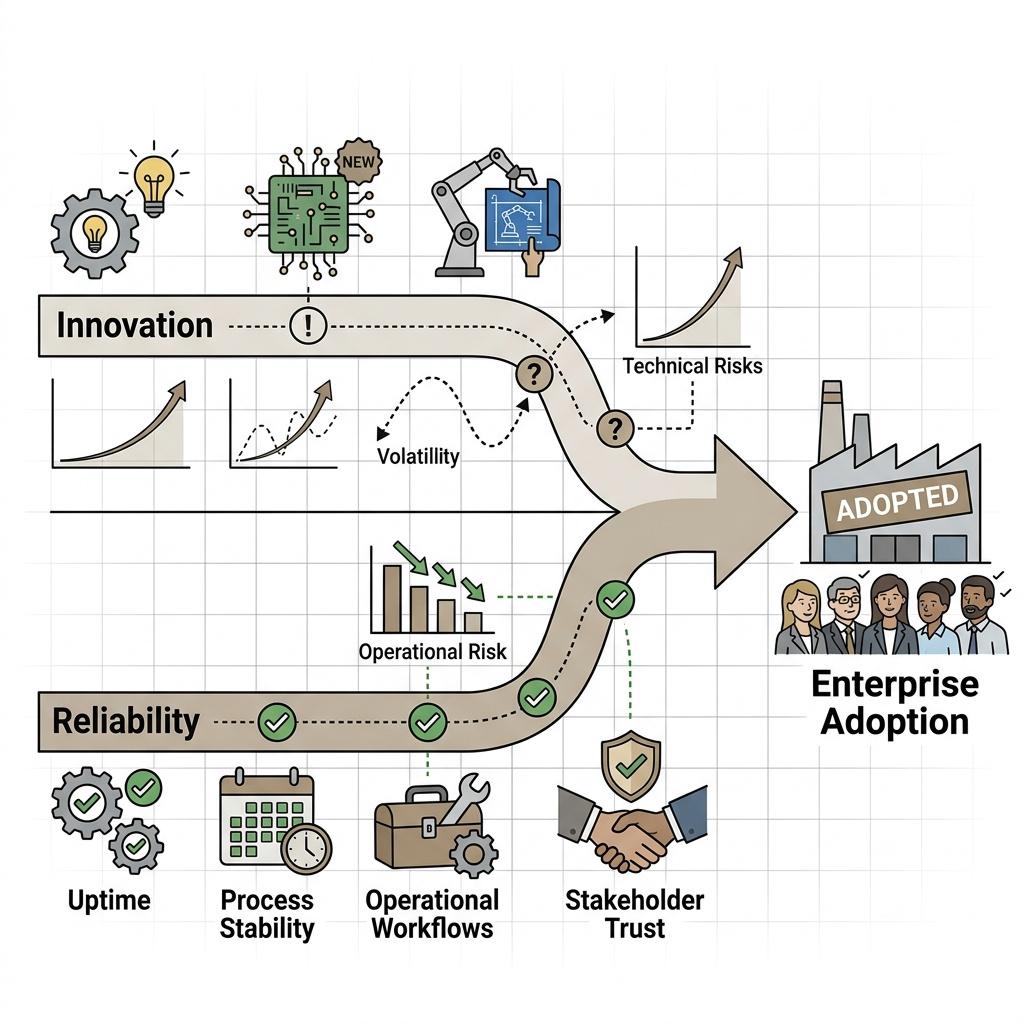
Innovation is inherently exciting.
It creates curiosity.
It generates media coverage.
It attracts investor attention.
It helps robotics companies differentiate themselves in crowded markets.
But enterprise adoption operates under different incentives.
A warehouse operator is not rewarded for implementing the most innovative robot. A manufacturing executive is not promoted because they deployed the newest autonomy stack. A logistics leader does not receive recognition for introducing experimental technology into critical workflows.
They are rewarded for maintaining throughput, reducing risk, improving efficiency, and delivering consistent operational results.
This creates a fundamental tension.
Robotics companies often communicate around what makes their technology unique.
Enterprise buyers evaluate what makes the technology safe to implement.
Those are not the same conversation.
Innovation answers the question:
"What can this technology do?"
Reliability answers the question:
"What happens when something goes wrong?"
In enterprise environments, the second question frequently matters more than the first.
Many robotics founders view buyers as innovation seekers.
Most enterprise buyers see themselves as risk managers.
This distinction changes everything.
When evaluating robotics solutions, buyers are not simply assessing capability. They are assessing the organizational consequences of deployment.
Questions often include:
These concerns are not signs of resistance.
They are signs of accountability.
The larger the organization, the more stakeholders become involved in evaluating potential risk.
Operations leaders assess process stability.
Engineering teams assess technical integration.
Procurement evaluates vendor viability.
Executive leadership evaluates strategic impact.
Legal and compliance teams may evaluate governance requirements.
As buying committees expand, reliability becomes increasingly important because reliability aligns stakeholders around certainty.
Innovation can create enthusiasm.
Reliability creates consensus.
One of the most common positioning mistakes in robotics is emphasizing technological sophistication while under-communicating operational dependability.
This often sounds like:
While these messages attract attention, they can unintentionally increase perceived risk.
Buyers may begin asking questions such as:
Novelty can trigger uncertainty.
This challenge has been observed across technology adoption research for decades. Studies examining innovation adoption behavior consistently show that perceived complexity and uncertainty often slow adoption, even when innovations provide meaningful improvements.
The lesson is not that innovation should be hidden.
The lesson is that innovation should be translated into operational outcomes.
Instead of leading with technical novelty, successful robotics companies often connect innovation directly to reliability.
Not:
"We built a more advanced autonomy engine."
But:
"Our autonomy system reduced intervention requirements by 40% across production deployments."
The first communicates innovation.
The second communicates trust.
When robotics companies hear the word reliability, many immediately think about system uptime.
While uptime matters, enterprise buyers evaluate reliability far more broadly.
Reliability exists across multiple layers.
Can the robot consistently perform its intended task?
Can performance remain stable across environmental variability?
Can the system recover from errors effectively?
Can the deployment fit within existing workflows?
Can maintenance procedures be executed consistently?
Can performance remain predictable under production conditions?
Can teams understand how to work with the system?
Can ownership be clearly defined?
Can leaders confidently explain deployment decisions internally?
Will the company continue supporting deployments?
Will implementation timelines be met?
Will commitments be honored over time?
Many robotics companies focus almost exclusively on technical reliability.
Enterprise buyers evaluate all four simultaneously.
A technically exceptional robot can still fail commercially if operational or organizational reliability remains unclear.
Trust is often discussed as a soft concept.
In robotics, trust is highly measurable.
Trust increases when buyers believe three things:
Research on organizational trust and reliability in technology adoption repeatedly highlights capability, consistency, and credibility as core drivers of trust formation.
This aligns closely with robotics adoption behavior.
Buyers do not need absolute certainty.
They need sufficient certainty to justify action.
That threshold becomes easier to reach when reliability signals are visible throughout the buying journey.
Examples include:
Trust is rarely built through claims.
It is built through evidence.
Innovation often drives initial market entry.
Reliability drives market expansion.
The robotics companies that achieve broad deployment are rarely those with the most impressive demonstrations alone.
They are the companies that consistently reduce perceived risk.
This becomes especially important as robotics moves beyond innovators and early adopters.
Early buyers are willing to tolerate uncertainty.
Mainstream buyers are not.
As markets mature, evaluation criteria shift.
Novel capabilities become expected.
Reliability becomes differentiated.
We see similar patterns across enterprise technology markets. As organizations move from experimentation to operational deployment, governance, predictability, and reliability increasingly become primary evaluation criteria.
In many cases, the most scalable growth strategy is not creating additional innovation narratives.
It is making reliability easier to understand.
The strongest robotics companies do not choose between innovation and reliability.
They connect them.
Innovation remains important because it creates value.
Reliability remains important because it enables adoption.
The challenge is sequencing.
Innovation explains why the solution matters.
Reliability explains why the buyer should trust it.
That distinction becomes particularly important during long enterprise sales cycles where multiple stakeholders must align around a single decision.
Organizations rarely reject robotics because they do not see potential.
They reject robotics because uncertainty outweighs confidence.
The companies that win consistently are often the ones that reduce uncertainty most effectively.
This is why adoption-focused positioning matters.
It is why deployment stories outperform feature lists.
It is why operational evidence outperforms technical claims.
And it is why a strong go-to-market strategy often benefits from partnering with a specialized robotics marketing company that understands enterprise adoption dynamics, stakeholder alignment, and operational risk.
The robotics industry often celebrates innovation because innovation is visible.
Reliability is quieter.
It rarely generates headlines.
It does not always create viral demonstrations.
But reliability is what transforms interest into deployment and pilots into scale.
Traditional growth thinking assumes buyers adopt technology because it is new.
Adoption-first thinking recognizes that buyers adopt technology because it feels safe enough to trust.
Innovation may open the door.
Reliability is what gets organizations to walk through it.
For robotics companies seeking sustainable growth, the question is no longer whether the technology is innovative.
The question is whether the market believes it is reliable.
That is where adoption begins.
Let's build something revolutionary - together