
menu
What category does your robotics company belong to?
For many founders and GTM leaders, that question seems simple. Industrial automation. Autonomous mobile robots. Inspection robotics. Warehouse automation. AI-powered robotics.
Yet the longer enterprise buyers look at the market, the more confusing those labels become.
A robotics company may combine software, AI, sensing, autonomy, hardware, workflow orchestration, and services into a single solution. Meanwhile, buyers are trying to evaluate operational risk, deployment complexity, integration requirements, ROI timelines, workforce impact, and long-term support.
The result is a common growth challenge across the robotics industry: companies struggle to explain what they are in a way that aligns with how buyers actually make decisions.
Most teams assume this is a messaging problem.
In reality, it is often a category problem.
The issue is not that buyers do not understand the technology. The issue is that buyers do not know where the solution fits within their operational reality.
At Robo Success growth systems for robotics companies, we frequently see robotics companies invest heavily in product development, technical differentiation, and sales enablement while overlooking the category definition work that makes adoption easier. The companies that gain traction fastest are often not those with the most advanced technology, but those that create clarity around the problem they solve and the role they play in the broader operational system.
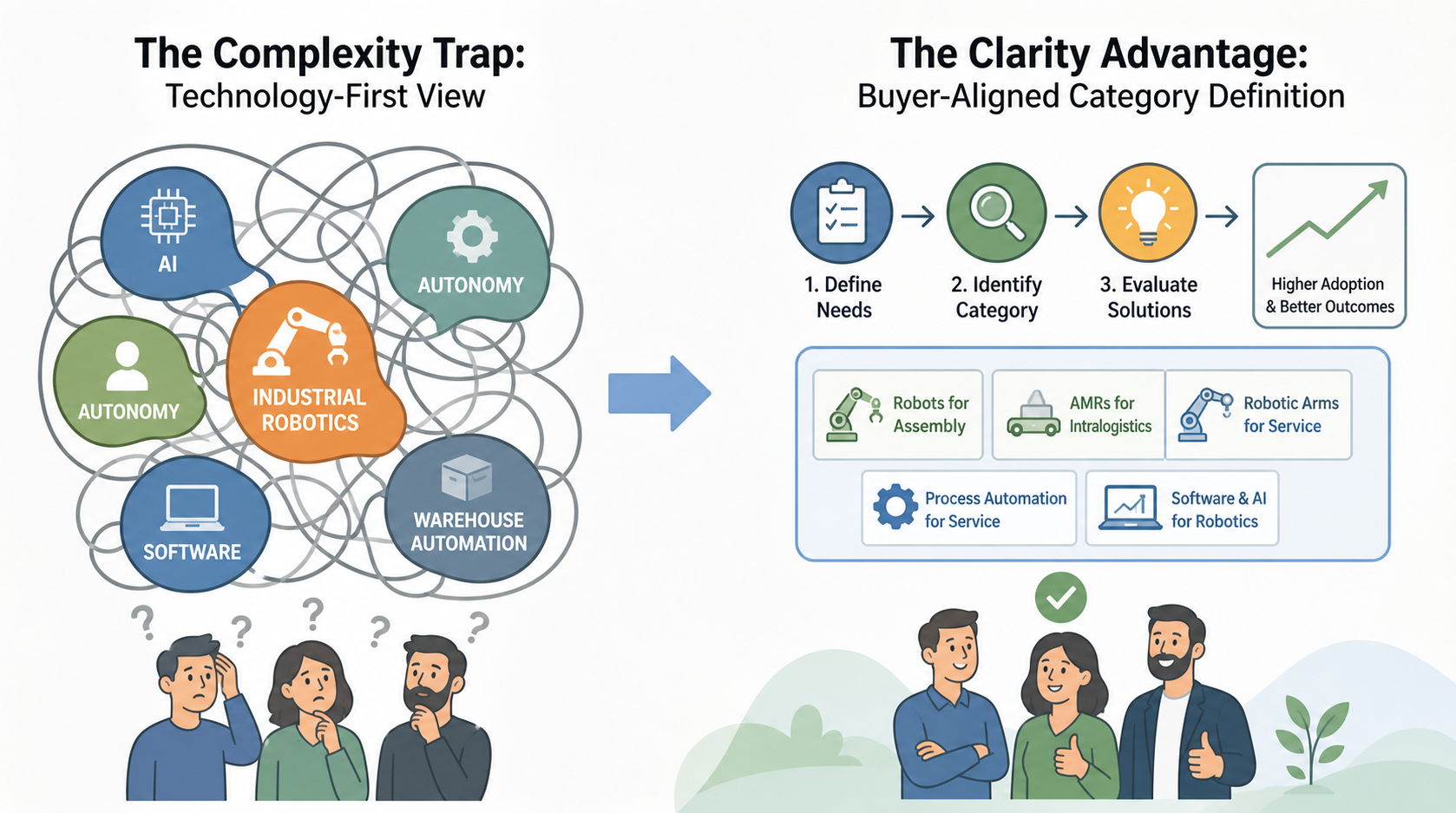
Founders often think about categories as positioning exercises.
Enterprise buyers experience them differently.
A category is a decision-making shortcut.
When buyers can place a solution into a familiar mental model, they immediately understand:
Without a category, every conversation starts from zero.
This becomes particularly challenging in robotics because robotics solutions rarely fit neatly into existing organizational structures.
A warehouse robotics platform may involve operations leaders, IT teams, safety managers, finance stakeholders, procurement, and executive leadership.
If every stakeholder defines the solution differently, internal alignment becomes difficult.
The sale slows down.
Not because the technology lacks value.
Because the organization lacks a shared understanding.
Research on category creation consistently shows that markets are shaped not only by products but by the frameworks buyers use to understand them. Companies that define categories successfully often influence how buyers interpret emerging problems and evaluate solutions. Research on category creation
Most software categories eventually stabilize.
Robotics rarely does.
The industry sits at the intersection of multiple domains:
As a result, robotics companies frequently describe themselves through technical capabilities rather than business outcomes.
A founder may describe a solution as:
While technically accurate, these descriptions often fail to answer the question enterprise buyers actually care about:
"What operational problem does this solve?"
When companies define themselves primarily through technology, they unintentionally increase buyer uncertainty.
And uncertainty slows adoption.
Most robotics leaders underestimate the financial impact of category confusion. The consequences appear everywhere.
Marketing teams struggle to create consistent narratives. Sales teams explain the company differently in every meeting.
Product teams prioritize features that reinforce technical leadership rather than market understanding.
Investors hear multiple versions of the same story. Enterprise buyers cannot confidently advocate internally.
Over time, category ambiguity creates friction across the entire growth system.
This friction rarely appears in dashboards.
It appears in longer sales cycles.
Delayed decisions.
Pilot programs that never scale.
Stakeholders who agree the technology is impressive but hesitate to move forward.
In enterprise robotics, hesitation is expensive.
Operational leaders are accountable for uptime, productivity, worker safety, and business continuity.
Their default response to uncertainty is not adoption.
It is delay.
The strongest robotics companies understand an important principle:
Buyers are not purchasing robots.
They are purchasing reduced operational risk.
The robot is simply the mechanism.
This reframes category strategy entirely.
Instead of asking:
"What technology category are we creating?"
The more useful question becomes:
"What risk category are we helping buyers eliminate?"
For example:
A warehouse automation company may believe it sells autonomous mobile robots.
An operations leader may believe they are purchasing labor continuity.
A manufacturing customer may believe they are purchasing production consistency.
A logistics executive may believe they are purchasing throughput reliability.
The winning category is often closer to the buyer's perception than the company's technical architecture.
This is why category definition is fundamentally an adoption exercise rather than a branding exercise.
Many robotics companies rely on technical superiority as their primary growth strategy.
- Better perception.
- Better autonomy.
- Better navigation.
- Better manipulation.
- Better AI.
These capabilities matter.
But enterprise markets rarely reward technical advantages alone.
Buyers need context before they can appreciate differentiation.
If the market does not understand the category, it cannot understand why your solution is better.
This is one reason category leadership often outperforms feature leadership.
The most successful companies do not simply introduce innovations.
They shape how buyers think about the underlying problem.
As discussions around market creation and category design have demonstrated, companies that define how a market understands a challenge often gain disproportionate influence over purchasing decisions. Research on category design and scale
For robotics companies, this means technical excellence and category clarity must work together.
One without the other creates growth constraints.
Another common misconception is that category work is primarily external.
In reality, the first audience is internal.
Before customers understand the category, employees must understand it.
The strongest robotics organizations align around a shared narrative that connects:
When category definition becomes consistent internally, external communication becomes significantly easier.
Enterprise buyers notice this immediately.
The company appears more mature.
The roadmap feels more coherent.
The risk profile feels lower.
Trust increases.
Trust accelerates adoption.
This is why category definition should be viewed as a business system rather than a marketing initiative.
Organizations that treat it as a system create consistency across every customer touchpoint.
The robotics industry is entering a period of rapid expansion.
New technologies will continue emerging.
New deployment models will appear.
New forms of physical AI will reshape operational environments.
As the market becomes more crowded, technical innovation alone will not create differentiation.
Clarity will.
The companies that win will not necessarily be those building the most sophisticated robots.
They will be the companies that make adoption feel safest, simplest, and most understandable.
Category definition plays a central role in that process.
It helps buyers understand where a solution fits.
It helps stakeholders align internally.
It helps organizations justify investment decisions.
Most importantly, it reduces the uncertainty that slows enterprise adoption.
Many robotics companies believe their growth challenges stem from awareness, lead generation, or competitive pressure.
Often, the deeper issue is category clarity.
When buyers cannot clearly understand where a solution fits, trust erodes, adoption slows, and sales cycles lengthen.
Traditional growth thinking focuses on explaining products more effectively.
Adoption-first thinking focuses on helping buyers understand the problem differently and positioning the company within a category that supports confident decision-making.
That shift may seem subtle.
In enterprise robotics, it can fundamentally change how markets respond.
If your organization is working to accelerate adoption, strengthen positioning, and create greater market clarity, Robo Success helps robotics companies build the systems, narratives, and growth foundations that make enterprise adoption easier.
Let's build something revolutionary - together